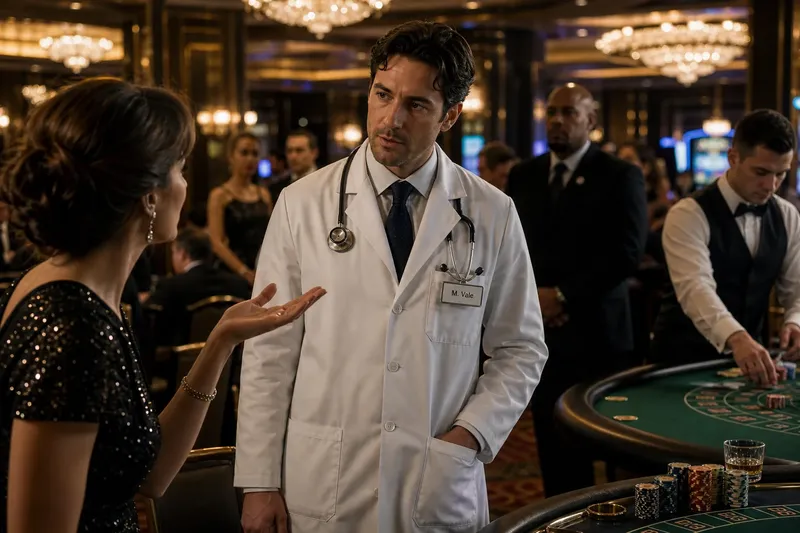
The Doctor at the Casino Table Is a Story Role, Not a Clinical Portrait
The doctor at a casino table turns care into a wager. Learn to read the scene’s choices and consequences without mistaking dramatic risk for medical guidance.
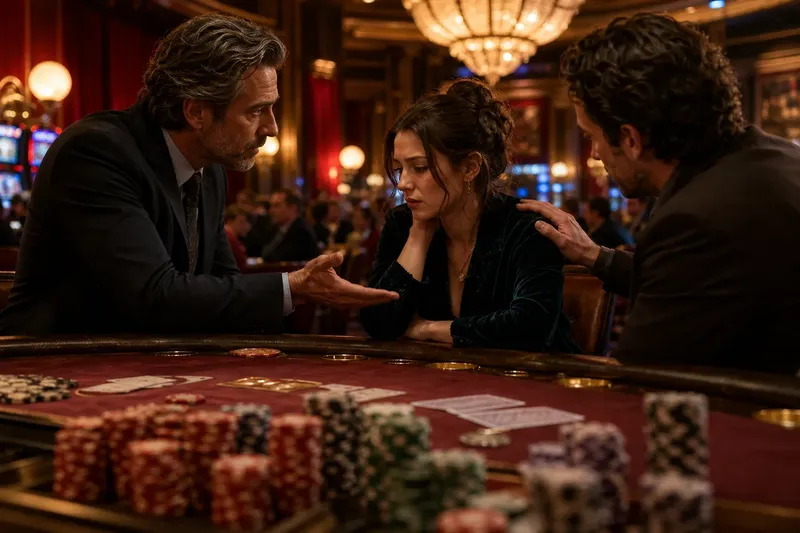
A doctor at a casino table can make another person’s health feel like the night’s biggest stake. The doctor at a casino table is a story role, not a clinical portrait: chips, bets and suspense shape how viewers interpret risk, but they do not explain the person’s needs or choices.
Risk as a wager
Casino scenes make risk visible through objects and rules. A stack of chips can stand for what might be lost; a card turned face down can hold back an answer. These images may create suspense, but they also invite viewers to watch another person’s uncertainty as entertainment.
That tension is distinct from a scene’s display of authority. The more useful question is not whether the doctor seems convincing, but whether the person whose health is at issue can shape what happens. A wager has players, stakes and spectators; care involves someone who should not be reduced to any of those roles.
Notice whether the scene treats uncertainty as a shared problem or a spectacle for the table.
Agency beyond the bet
Casino language can make a decision sound like a gamble with a winner and a loser. That framing may leave little room for a person to ask what is happening, say what matters to them or decline an action. Watch for those possibilities in the dialogue and blocking.
Agency is not the same as being shown in close-up or given a dramatic line. A scene gives a person more room to act when their words affect what follows; it narrows that room when companions, doctors or gamblers make choices around them without showing their response.
Track who changes the course of the scene, not just who occupies the centre of the frame.
Reading casino scenes?
Why place a doctor at a casino table?
The setting can make professional duty collide with a game’s atmosphere of risk, secrecy or chance. It can also create tension without clarifying what the person at the centre of the scene knows or wants.
Do chips reveal what is at stake?
Chips tell viewers how the story visualises risk; they do not describe a person’s condition or the choices available to them. Look to the person’s words and the scene’s actions to understand what the story actually establishes.
What shows that a character has agency?
Look for whether the person can ask questions, express a preference, refuse, or change the next action. If other characters decide everything, the scene has not shown that person’s agreement.
Can the scene guide a real health decision?
A fictional scene can prompt questions about power and uncertainty, but it cannot establish what care a real person needs. For a real concern, seek advice from a qualified health professional or a dependable health service.
Choices in the scene
Use these observations to decide what the scene supports, and what it leaves open:
- Who speaks: If the person whose health is at issue states a preference, read that preference as part of the scene; if others speak for them, leave their own view unresolved and look for another moment that gives them a voice.
- Who sets the terms: If the person can shape the choice, read the wager metaphor as contested; if another character controls every option, focus on that imbalance rather than assuming consent.
- What counts as a stake: If the scene names a specific consequence, consider that consequence part of the story; if it relies only on chips or ominous glances, treat the stakes as symbolic and unresolved.
- How chance enters: If a card draw or bet changes events, read chance as a plot device; if the scene gives no link between the game and the decision, keep the two actions separate.
- Who watches: If spectators react to the person’s situation, consider how the scene turns vulnerability into display; if the focus shifts to the person’s response, attend to what they choose or communicate.
- What follows: If the scene shows a conversation or further action, use those details to understand what happens next; if it cuts away, leave the outcome open rather than supplying one.
Two readings, one scene
Imagine an invented scene with one player, one doctor and one companion at a card table. The player has stopped following the game; the doctor pauses play, offers to leave with them, and the player agrees. The companion joins them as the camera stays behind with the chips.
Start with the visible sequence: the game stops, the player accepts the offer, and the companion leaves too. The observable result is that the player is no longer at the table and is accompanied; the scene does not show why the player lost track of the game or what happens afterwards.
One reading is that the player’s agreement changes the course of the scene: the wager gives way to their choice to leave. Another is that the camera’s attention to the chips preserves suspense for the spectators. The first reading foregrounds agency; the second foregrounds the game’s hold on the story. Neither supplies a diagnosis or a real-world care decision.
What the metaphor leaves out
A wager makes uncertainty look like a contest whose outcome will soon be revealed. A person’s experience may remain more complicated than that structure allows, especially when the scene gives more attention to the bet than to what the person says or chooses.
Read the doctor at the casino table by asking who controls the wager, who can alter the terms and whose account is missing. That approach keeps the casino imagery useful as a way to discuss agency and risk, without treating a fictional character or a dramatic reveal as guidance about real care.
If the scene raises a real health question, bring it to a qualified professional or dependable health service. A story can frame uncertainty; the person’s circumstances and appropriate professional advice must inform decisions about care.